
AUGMENTED REALITY IN EDUCATION
This week will focus on Augmented reality but more specifically about applications such as Zappar which can enhance engagement and learning experiences within the classroom.
Augmented Reality in the classroom
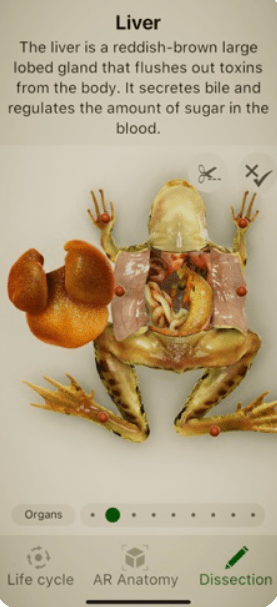
Bower, Howe, McCredie, Robinson and Grover (2014) argue that Augmented reality currently has many affordances which can be of benefit to classroom pedagogies. Augmented reality can allow the sharing of creations, that students have designed themselves, through easily accessible applications (Bower et al., 2014). Various applications for augmented reality are easily accessible and free on mobile phones and can help students conceptualise concepts, cut costs, and increase engagement (Akçayır & Akçayır, 2017). For example, the application Froggipedia enables students to visualize the anatomy of a frog and understand the inner workings at a deeper level without the need for real life samples to dissect (Designmate, 2020). The image below (from Froggipedia) shows how students can learn about the organs of a frog via this free to download app available on their phones and provides various other features for an engaging, fun an interesting time whilst in a science class (Bower et al., 2014; Designmate, 2020).
Zappar/Zapworks for creativity
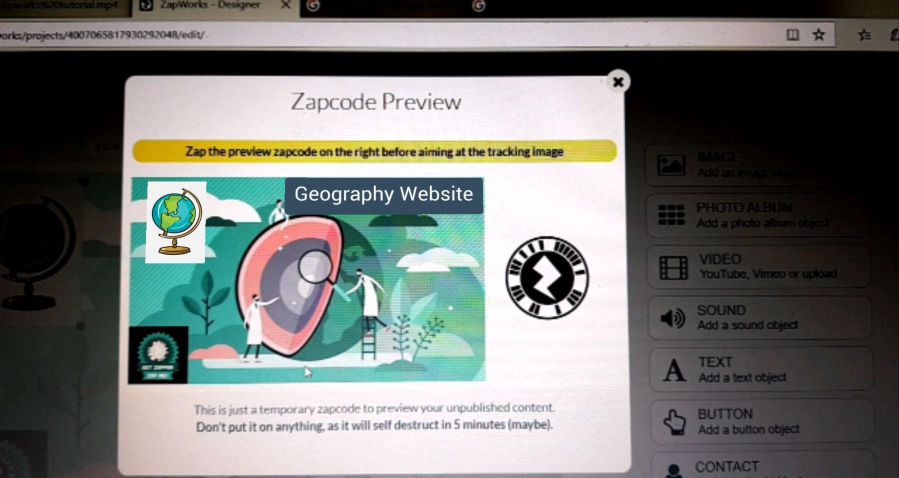
Students are able to create their own Augmented reality (AR) codes to scan with Zapworks and share with the class (Zapworks, 2020). Students can customize what the code or “trigger image” will show in Augmented reality for others to see with the website and all they need is to paste the zap code onto a corner of their image (Zapworks, 2020). With AR creation tools like these, they can foster student creativity and problem solving through higher order thinking e.g. designing 3D models or buttons for their peers to interact with on their phone (Bower et al., 2014). As Bower et al., (2014) encourages, these applications also bring meaningful learning to students as their own creations in AR ignite and motivate their interests in the subject they are learning.
Issues
Akçayır & Akçayır, (2017) state that as with all technology, there are always technical difficulties that can arise with these Augmented reality applications. Aside from this, having these applications be accessed on a phone or other devices raises the concern of distraction as students could easily switch to something else on their phones whilst ignoring the task at hand (Akçayır & Akçayır, 2017).
Reference List
Akçayır, Murat, & Akçayır, Gökçe. (2017). Advantages and challenges associated with augmented reality for education: A systematic review of the literature. Educational Research Review, 20, 1-11.
Bower, M., Howe, C., Mccredie, N., Robinson, A., & Grover, D. (2014). Augmented Reality in education – cases, places and potentials. Educational Media International, 51(1), 1-15.
Designmate, (2020). Froggipedia. Retrieved from: https://apps.apple.com/us/app/froggipedia/id1348306157#?platform=ipad
Zapworks, (2020). Zapworks Designer. Retrieved from: https://zap.works/designer/
 EDUC3620 Digital Creativity and Learning
Hi Steven, awesome blog post on Augmented Reality. The incorporation of the app Froggipedia is great to get all students interactive as they are engaging in an creative experience. I totally agree with you about the issues regarding Augmented Reality as I do believe that technology is not always reliable and can lead to larger complications. Technology can become distracting for students and as future teachers we need to take this into consideration as we want our students to be able to develop and build on their creative skills while also learning appropriate content.
LikeLike