
Virtual Reality
Above image from: https://www.mining-technology.com/features/featurereality-check-augmented-and-virtual-technology-in-the-mining-industry-4913055/
This week will focus on the wide range of applications of Virtual reality (VR) in education.
Why Virtual reality?
Similar to Augmented reality, Virtual reality can provide a sense of immersion through the use of sensory, symbolic and actionable activities (Dede, 2009). The potential affordances that come from VR can be greatly beneficial to learning when linked to curriculum tasks and used effectively (Dede, 2009). Lee et al., (2016) outlines that design of the virtual environment is crucial as pairing affordances to suit the learning outcomes of the curriculum will enhance student experiences and further engagement and motivation within students. Southgate, (2018), highlights that VR can provide constructivist learning through first hand experience, introduction of basic semantics, or more complex and abstract concepts that students would understand better if shown visually.
CoSpaces
CoSpaces is a virtual and augmented reality educational tool that has a wide array of affordances for learning and pedagogy in the classroom (CoSpaces, 2020). Students are able to create 3D and 360 degree worlds via the website and are given the ability to design, construct, recreate, and share their works through virtual worlds or even virtual reality headsets (Southgate, 2018; CoSpaces, 2020). The collaborative aspect of CoSpaces, if implemented effectively in classroom activities, can allow for meaningful and engaging learning experiences.
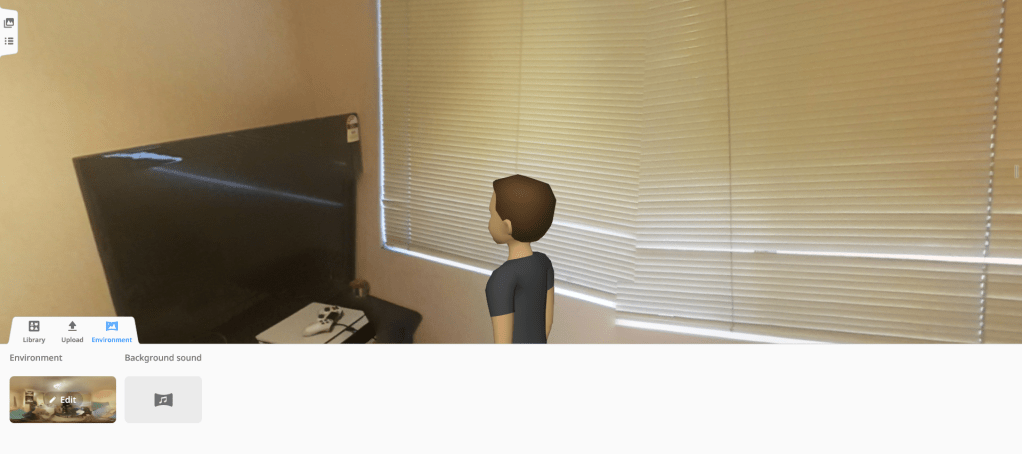
The image below shows that students are able to upload their own 360 images to fill in for whatever environments they like and can even insert characters into the scene (CoSpaces, 2020).
This second image below depicts the coding blocks option in which students are able to assign different animations for the characters to do in their constructed world (CoSpaces, 2020).
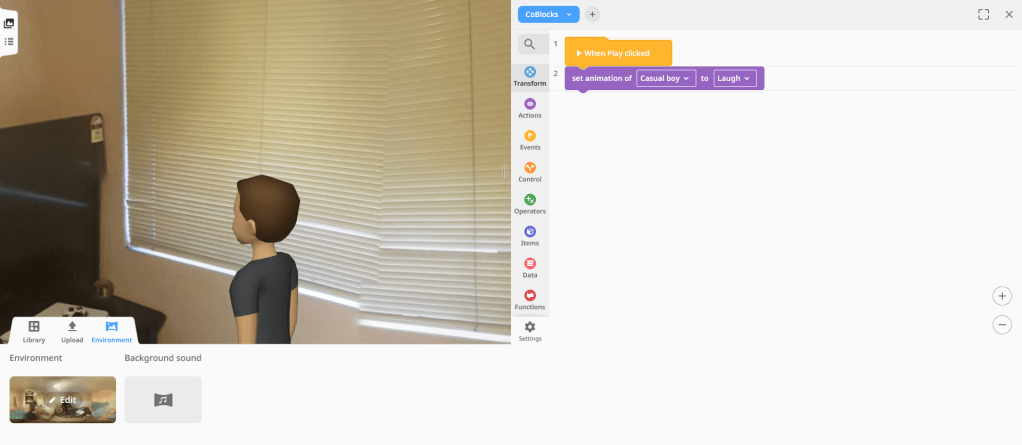
The easily accessible and simple to learn CoSpaces tool is perfect for fostering student creativity and higher order thinking as their is a wide range of actions in the coding blocks to experiment with (CoSpaces, 2020;Lee et al., 2016).
Challenges
As with all technology, Virtual reality has issues such as the potential for technical issues to arise. Additionally, Southgate, (2018) addresses the healthy and safety concerns of using VR headsets such as psychological risks during long term immersions. However further research and improvement of VR can help mitigate these issues and its benefits will surely be of great use in future learning.
Reference List
CoSpaces. (2020). Make AR & VR in the classroom. Delightex. Retrieved from: https://cospaces.io/edu/
Dede, C. (2009). Immersive interfaces for engagement and learning. science, 323(5910), 66-69.
Southgate, E. (2018). Immersive virtual reality, children and school education: A literature review for teachers.
Lee, M., Tynan, Belinda, Dalgarno, Barney, & Gregory, Sue. (2016). Learning in virtual worlds : Research and applications / edited by Sue Gregory, Mark J.W. Lee, Barney Dalgarno, and Belinda Tynan. (Issues in distance education series).
 EDUC3620 Digital Creativity and Learning
Hi Steven!
This is a great review of using VR to enhance learning. You’ve created a well-written and cohesive explanation of how VR can be used in an educational setting, the benefits of doing so and some of the challenges which may arise. By using CoSpaces as an example, you’ve shown how VR can be utilised in any subject-area or year level and the addition of multiple images gives us a deeper understanding of how CoSpaces works (and how easy it is to use). You could expand on this information by mentioning how CoSpaces could be used in a specific subject (e.g. students in a year 11 ancient history class could use CoSpaces to explore a virtual representation of Sparta).
Nice job!
LikeLike
You have done a really good job at explaining what VR is and how it can be used to assist in enhancing student creativity through an application such as CoSpaces. It was also good to see that you provided the detrimental aspects or challenges VR has in relation to psychological risks or technical issues. You also did well to suggest that further research may be able to mitigate these issues, which as it is an emerging technology, is bound to have issues that can be rectified through further research. Perhaps my only addition that my improve this would be to specify the detrimental aspects that VR has in an educational context such as little physical space within a classroom or little space in the curriculum to allow for education through VR.
LikeLike