
Constructionism
Above image from: https://classroom.littlebits.com/projects/rc-car-0c993f0b-d422-4071-9590-7e1d04937638
This week the theory of constructionism will be explored and how learning through doing is achieved.
Why Constructionism?
Donaldson, (2014) claims that learning is an active process whereby firsthand experiences are used to construct meaning, ideas and knowledge and is what shapes our understanding of the world. Additionally, when meaningful experiences become personal, the construction of new knowledge will be enhanced (Donaldson, 2014). For example, when students are allowed to create, design or construct products such as robots or other crafts, a personal connection to that product is formed and the process becomes engaging to them (Donaldson, 2014).
The theory has spawned a movement around making as a way to effectively learn in schools which is named the ‘The maker movement’ (Martinez and Stager, 2014). Martinez and Stager, (2014) advocate for the potential of learning through creation and encourages schools to go beyond the textbook and standardised ways of learning. The movement views students as capable and competent learners who can create and construct materials, objects, code, programs, etc. Martinez and Stager, (2014) state that students should be able to enjoy and become lost in the process of making projects and this will in turn enable them to learn what they need to against the curriculum whilst enjoying the meaningful experiences that the makerspaces provide.
LittleBits
LittleBits is one of the technologies that can aid in facilitating the ‘maker’ approach to learning (Sphero, 2020). The LittleBits kits that the company provides help student creativity and ingenuity develop through the process of creation where their ideas can manifest into physical forms (Sphero, 2020). The kits provide fun and meaningful learning experiences, as well as crucial real world skills needed for the future leaders of the world (Sphero, 2020).
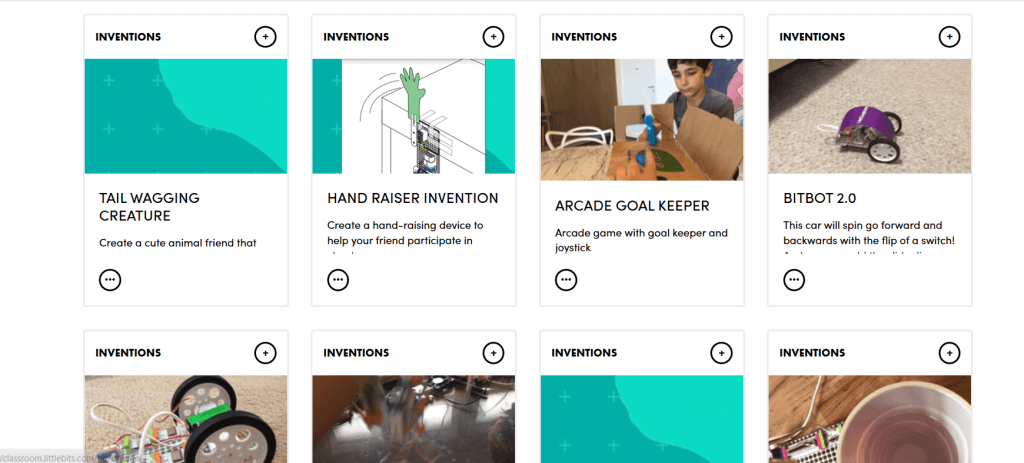
From the image above, there is an array of projects and builds to choose from and student’s own creations can be shared to the ever growing repertoire of inventions (Sphero, 2020).
Issues
Many of the issues that teachers have expressed revolved around the support or lack thereof for the implementation of this way of learning (Bower et al., 2018). Resources and funding would need to be heavily considered when teachers want to utilise the makerspace approach of learning which was also a major concern (Bower et al., 2018). Additional technical difficulties and troubleshoot could arise when designing tasks or executing them as with all technology (Bower et al., 2018). However with continual improvement of technology and a change in mindset over time, this new makerspace learning approach would be revolutionary.
Reference List
Bower, M., Stevenson, M., Falloon, G., Forbes, A., & Hatzigianni, M. (2018). Makerspaces in primary school settings: advancing 21st century and STEM capabilities using 3D design and printing.
Donaldson, J. (2014). The Maker Movement and the rebirth of Constructionism. Hybrid Pedagogy
Martinez, S., & Stager, G. (2014). The maker movement: A learning revolution. Learning & Leading with Technology.
Sphero, (2020). LittleBits Classroom. Retrieved from: https://classroom.littlebits.com/welcome
 EDUC3620 Digital Creativity and Learning
A great post! I thoroughly enjoyed reading your post, especially how you not only explain what constructionism is, but also provide examples of its use and benefits. You provide a great overview of the pedagogy, as well as it related to the technology. I also agree with your point regarding the issues and limitations of makerspaces, being the lack of support and awareness of maker spaces. However, I believe that educators also have a key role in facilitating students learning and experiences and are integral to the integration of makerspaces in our education.
LikeLike
The links between constructionism and the maker movement are very clear and well described in this and I like how you included LittleBits as it is a great example of a technology that aids the maker movement. Perhaps there could be more emphasis on creativity and how LittleBits and the maker movement in general can enhance creativity but overall, I really enjoyed this blog post.
LikeLike
Hi Jiacheng,
I enjoyed reading your post on construction and the maker movement.
You have shown a great understanding on constructionism and the idea that learning is an active process. Recognising little bits as a platform to encourage student to learn through making does show powerful links to the maker movement.
Resources and funding are two large issues that can arise when implementing these maker movement platforms into the classroom and therefore ensuring your school is able to afford these technologies is crucial.
Great blog!
LikeLike