
Games in Learning
From: https://www.frogger.net/
This week will demonstrates the benefits of gaming in education for students through playing and designing.
Why games?
Squire, (2006) outlines that it is important for teachers to learn about games as they have the potential to become the next step in learning or an evolution of learning. Games are able to create multiple learning paths and are not chained by the constraints that that a real life classroom may have (Squire, 2006). In games students and learners are able to co-construct identifies, ideas, values and worlds in their own way without being taught to think in a preset way (Squire, 2006).
Furthermore, Prensky, (2008) adds that these games also provide students and learners a platform to develop crucial skills like creativity, critical thinking and problem solving. This can be achieved through students designing and building the games themselves as a majority of students feel the motivation through learning this way (Prensky, 2008). When students are actively engaged in designing a game that is relevant to the curriculum, it enables them to develop and improve their cooperative skills, increase motivation through personalisation, and imagination and creativity. Additionally, Prensky, (2008) states that learning takes place during game creation and students learn better when they are in charge and look forwarding to the process itself.
However, Kangas et al., (2017) addresses that teachers should keep in mind that planning and development of lessons and activities need to be effective and with clear goals for students to learn what they need against the curriculum.
Scratch
Scratch is an example of a tool that could help facilitate this design learning process for games and also has the ability to share these creations with anyone (Prenksy, 2008; Scratch, 2020). As seen below, students can create games, animations, stories, etc. for peers to try but it also provides them with an opportunity to think computationally and learning about coding blocks (Scratch, 2020).
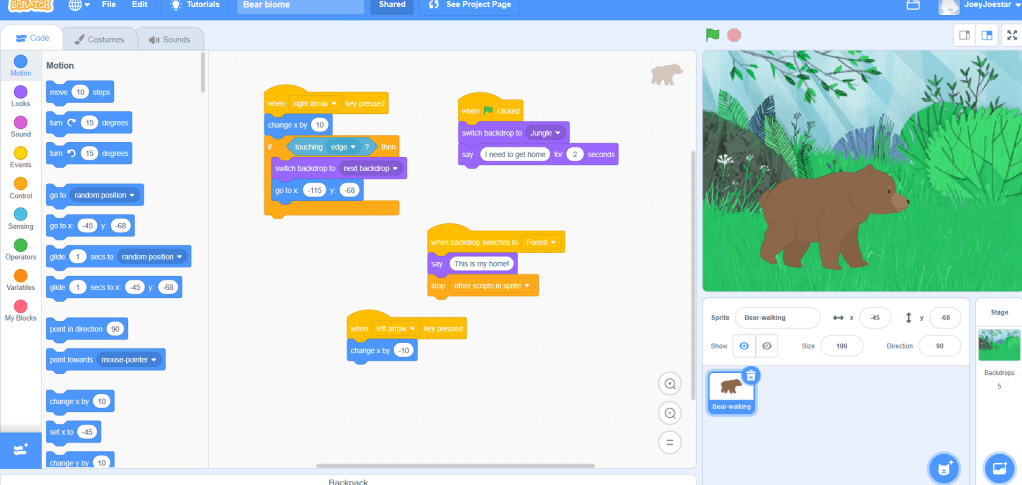
Click the link below to try out the game that was created using this tool.
https://scratch.mit.edu/projects/392441675
Reference List
Kangas, M., Koskinen, A., & Krokfors, L. (2017). A qualitative literature review of educational games in the classroom: the teacher’s pedagogical activities. Teachers and Teaching, 23(4), 451-470.
Prensky, M. (2008). Students as designers and creators of educational computer games. British Journal of Educational Technology, 39(6), pp. 1004-1019. Retrieved from: https://onlinelibrary.wiley.com/doi/epdf/10.1111/j.1467-8535.2008.00823_2.x
Scratch, (2020). Imagine, program, share. Retrieved: https://scratch.mit.edu/
Squire, K. (2006). From content to context: Videogames as designed experience. Educational Researcher, 35(8), pp. 19-29. Retrieved from: http://website.education.wisc.edu/kdsquire/tenure-files/18-ed%20researcher.pdf
 EDUC3620 Digital Creativity and Learning
Hi Jiacheng!
Your blog post brings forth some excellent points regarding the use of games in education and I agree with your discussion on how games could be beneficial to learning and the development of 21st century skills. I also agree that games offer a more engaging and motivating learning experience for students and believe that when used alongside effective teaching pedagogies, games could be the next step in learning as schools become more inclined and open to teaching through technology instead of sticking to traditional methods. I think that providing students with the opportunity to not only play games relevant to what they are learning but to also allow them to design their own with programs like Scratch enhances the affordance of games in education and supports further growth of creativity, collaboration, problem solving and critical thinking, which are all important skills for students to possess now.
Jiajin Han.
LikeLike